Symbols
Fire and Renewal in Visual Storytelling
Flame can destroy, reveal, transform or frame a scene; renewal is one reading, not an automatic definition.
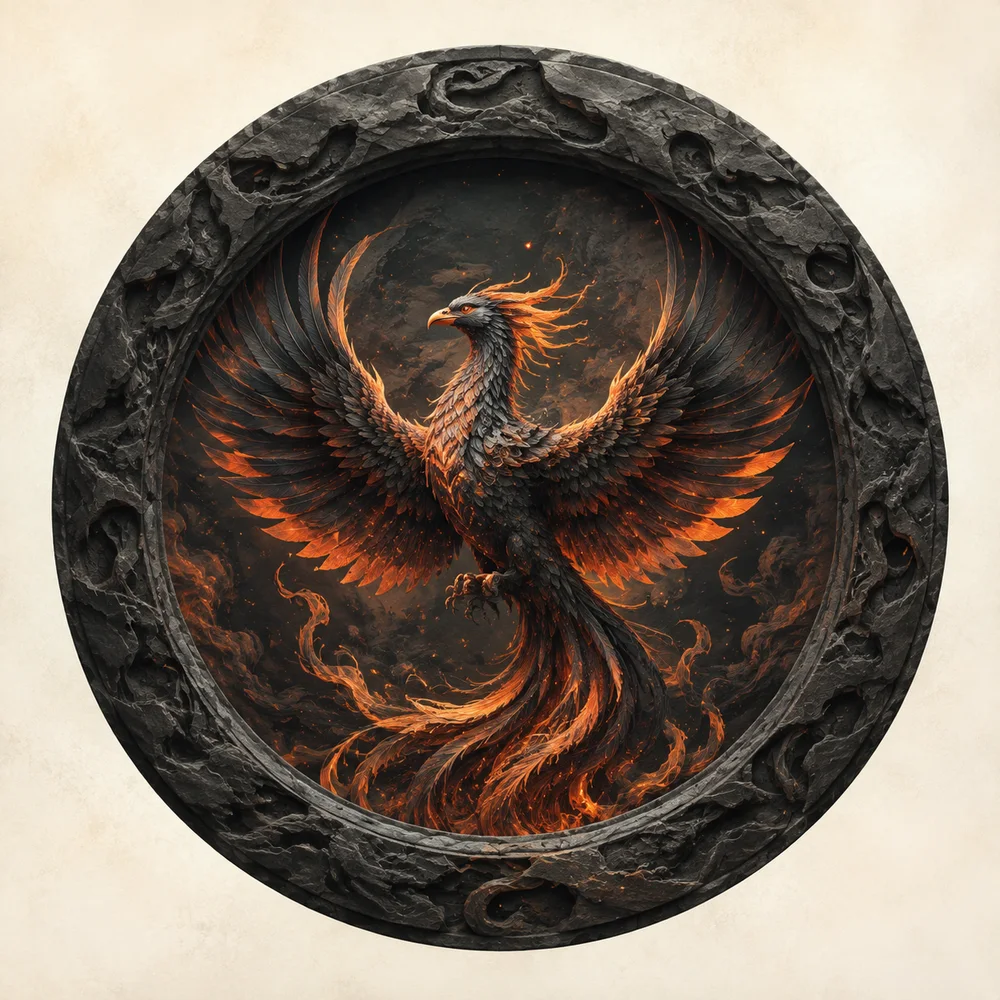
Fire is visually efficient. A bright edge against dark material creates immediate contrast, while sparks and rising shapes imply movement in a still image. Meaning is less automatic. The same represented flame can signal punishment, domestic warmth, divine presence, political power, danger or transformation depending on the work around it.
Separate optical function from symbolic claim
In the hero illustration, orange light outlines the bird and cuts it away from the charcoal stone. That is first a compositional function: high luminance contrast creates a focal area. The brighter center also makes the dark circular boundary appear heavier and more distant.
A viewer may connect this light to renewal because phoenix stories are nearby. That interpretation is reasonable within this page, but the color orange alone does not carry a universal dictionary meaning. A museum label, artist statement or historical text is needed before assigning a specific symbolic program to another artwork.
Notice how stories direct the flame
The medieval bestiary described by the Metropolitan Museum explicitly connects the phoenix’s return with Christian resurrection. There the written moral guides the picture. In other settings, fire may be an ordeal, a force of destruction or a sign of authority. The Getty exhibition Radiant Darkness surveys works in which artists used nocturnal light for several different religious, political and emotional effects.
This range is a useful correction to one-word symbolism. Instead of asking “What does fire mean?” ask who made the work, for which audience, in what narrative, and what the flame is doing. A small lamp beside a reader and a blaze around a mythical bird may share color while performing opposite emotional tasks.
Build a visual sequence
Artists can suggest transformation without depicting every stage. A dark lower field can imply what came before; a bright core can mark the change; upward feathers or sparks can establish direction. Repetition of small ember points carries the eye from the dense center into quieter space.
Restraint improves the sequence. If every edge glows equally, the eye has no route. Keep one primary light source, allow some forms to disappear into shadow and reserve the highest saturation for the intended turn in the story. These are design choices, not evidence of an ancient convention.
Caption the interpretation honestly
A useful caption names what is visible and what is inferred. “An original phoenix illustration with rim-lit wings inside a dark stone frame” describes the image. “A contemporary interpretation of return and transformation” identifies the editorial reading. Neither statement pretends that the image is a recovered artifact.
The same discipline applies when presenting historical work. Use the museum’s title, maker attribution, date, material and collection record; then distinguish curatorial interpretation from your own formal analysis. This makes room for ambiguity without turning every flame into the same promise.
Working takeaway
Describe what the light does in the composition before proposing what the fire may mean in its documented context.
Sources and scope
These references support the historical and terminological framework. They do not endorse this publication or its illustrations.
- The Metropolitan Museum of ArtA Medieval Bestiary
Medieval bestiary treatment of the phoenix and its Christian resurrection reading.
- National Gallery of ArtBurning Phoenix by Jacques Callot
Open-access collection record and visual description of a 1628 phoenix etching.
- Getty MuseumRadiant Darkness: The Art of Nocturnal Light
Examples showing that represented fire and light carry different meanings in different works.
- National Gallery of ArtThe Elements of Art: Symbolism and Place
Introductory framework for distinguishing a visible form from the idea assigned to it.